Simulating the Stimulating

Wednesday, January 7, 2009

I recently started reading Paul Krugman's column in the New York Times and was particularly interested in his mathematical analysis of Obama's $775b stimulus plan.

Based on his back-of-napkin calculations, I created a simple (and ugly) tool to simulate a stimulus's effect on unemployment. The tool is pre-populated for Obama's proposed stimulus.

The bottom line? Obama's proposal, if Okun's law holds, would result in a 6.75% increase in GDP and a 3.4% decrease in the expected unemployment.

Strangely, Krugman only shows the net result after one year (1.7% decrease in expected unemployment), not the net result by the end of the stimulus in 2 years. It's this first-year result that he is afraid is not enough to appear effective to conservatives. In fact, it almost sounds like he accidentally thought that his first-year calculations were the end-result:

"Suppose that we’re looking at an economy that, absent stimulus, would have an average unemployment rate of 9 percent over the next two years; this plan would cut that to 7.3 percent, which would be a help but could easily be spun by critics as a failure."


He may just be saying that the failure will be spun after just one year of the plan, but I'm still surprised he made no mention of the overall effect.

If you're interested, here are the mathy details:

"Okun's Law" relates GDP growth to unemployment. Assuming "Okun's coefficient" is 2, it says:

You need a 2% increase in GDP to reduce unemployment by 1%

So if we can increase GDP with, say, a stimulus, we can decrease unemployment. Here are some rules of thumb for how a stimulus increases GDP (Krugman's source):

For every $1 the government spends, they make $1.50
For every $1 cut in payroll taxes, they make $1.30
For every $1 cut in business taxes, they make $1

So a simplistic equation for decreasing unemployment by stimulus is:

Decrease in Unemployment = 100 *
[spending*1.5 + (payroll tax cuts)*1.29 + (business tax cuts)*1] / (2 * GDP)

UPDATE: Krugman also stated that the latest forecast is a high of 8.4% even with the stimulus going into 2010. Obviously this means there's some other variables at work here wonking with the equation.
My 2009 Reading List

Tuesday, January 6, 2009

Here's my list of books to read this year. I want to finish one a month, so I included the pages/day I'll need to do so, along with a brief description of the book and why I'm reading it.

August and September still need to be filled and I'd like to fill it with something recommended by friends. Preferably something non-fantasy like contemporary fiction, or philosophy or something.

MonthBookPages/dayNotes
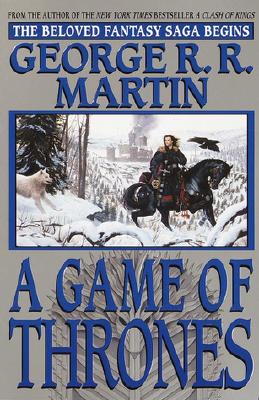
JanuaryA Game of Thrones30First of the fantastic "Song of Ice and Fire" series. Low-magic, realistic, political, well-written, great character depth, and a wintery landscape to match the season.I read this once years ago and Julia has been bugging me ever since to finish the series. I'm re-reading this so I'm on the same page as the Clash of Kings, so to speak.

Started: 1/7/09
Finished: 1/20/09
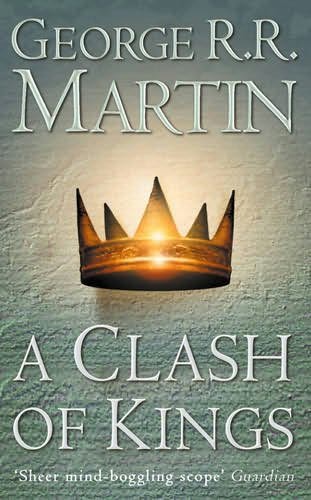
FebruaryA Clash of Kings352nd book of SoIaF. Got about 50 pages into this but never finished

Started: 1/20/09
Finished: 2/3/09
MarchA Storm of Swords403rd book of SoIaF

Started: 2/3/09
Finished: 2/26/09
AprilA Feast for Crows264th in SoIaF. The 5th book, "A Dance with Dragons" (see below) should be coming out this month.

Started: 2/26/09
MayA Dance with Dragons33Book will hopefully be out by now and someone will have gotten it for my birthday ;)
JuneThe Crying of Lot 496Needed something to break up the Fantasy settings. My friend Spencer recommended this book by Thomas Pynchon. I originally considered reading "Gravity's Rainbow" but he suggested this would be a better (and far shorter) introduction to a notoriously complex author.
JulyDante's Inferno10The first of three parts to Dante's "Divine Comedy" written in the 1300s. Dante travels through the 7 layers of hell. Figured it would be good for summer :)
August?Any suggestions?
September?Any suggestions?
October17Yes, it's true. I've never read the Lord of the Rings trilogy. I've read "The Hobbit" and 60% of "Fellowship of the Ring", but none of the others.I should be cast into the flames of Mount Doom.
November152nd of the LoTR trilogy
DecemberReturn of the King
183rd of the LoTR trilogy

New Year's Resolutions: 2009 Edition

NYR 1: Read 12 books

NYR 2: Sign a 12-month lease at a new place

NYR 3: Spend 5% less each month for 12 months

The "MPG Illusion"

Monday, January 5, 2009

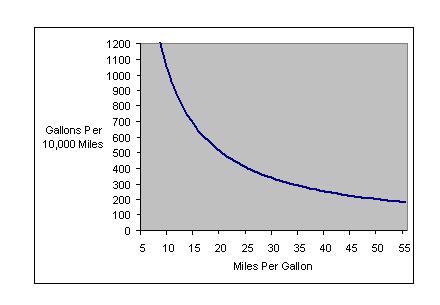
If you're interested in fuel economy, either for environmental or economic purposes, you'd probably be interested in reading this article. It raises a very interesting mathematical point about the miles per gallon measurement: increases in your MPG do not give proportional decreases in fuel consumption. Or to put it more concretely, you save as much money switching from a 10 mpg car to a 15 mpg car as you would going from a 15 mpg car to a 30 mpg car!

Why is this? Well, if you think of it in terms of gallons per mile -- which tells you exactly how much fuel you consume as you drive -- rather than miles per gallon, you get the inverse of a linear function:


Note that the jump from 10 to 15 is the same as the jump from 15 to 30!

Just an interesting tidbit to consider before buying a car based on MPG.

 
Geek of all Trades - Wordpress Themes is powered by WordPress. Theme designed by Web Hosting Geeks and Top WordPress Themes.
por Templates Novo Blogger